Quick answer: For illustration specifically, our record favours RISD. Among 68 Royal Blue acceptances to RISD since 2009, 14 entered Illustration — the second largest group after Graphic Design (23). At Parsons, illustration accounted for just 4 of 63. The funding picture reverses that: Parsons funded 60% of our admits and RISD 6%. Strong department at one, better economics at the other.
If you are trying to decide between RISD and Parsons for illustration, you are weighing two of the most respected programs in the country — with meaningfully different cultures, structures, and career trajectories. This guide compares RISD vs Parsons for illustration honestly, based on what each school actually offers and what kind of student tends to thrive in each environment.
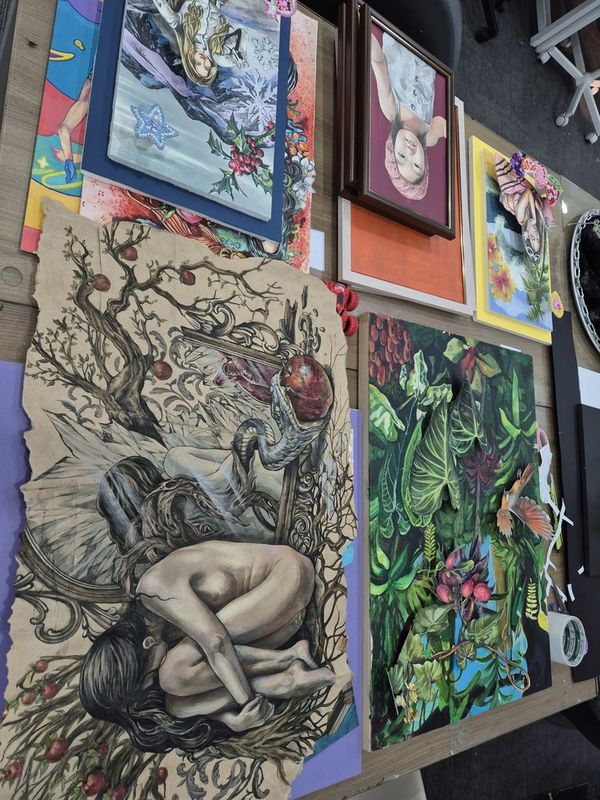
RISD Illustration: What You Need to Know
RISD’s Illustration program is one of the oldest and most established in the country. It is housed within a dedicated fine arts culture that values hand skills, observational drawing, and the development of a distinctive visual voice. RISD illustrators are trained to think about image-making as an art form with its own history and logic — not primarily as a service to clients or publishing markets.
Key Insight: Illustration Programs
Illustration programs vary enormously—some focus on narrative and editorial work, others on character design and animation. The strongest programs develop both a distinctive personal style and commercial versatility. Faculty connections to publishing, animation, and games industries can be decisive for career outcomes.
Frequently Asked Questions
Q1. What are the key differences between RISD and PARSONS?
The program is highly studio-intensive. Students spend significant time on fundamentals — drawing, painting, printmaking — before specializing. The faculty includes working illustrators with strong editorial and publishing careers. RISD’s illustration alumni have strong representation in editorial illustration, picture books, and gallery-adjacent image-making.
Parsons Illustration: What You Need to Know
Parsons does not offer a dedicated Illustration BFA. Students interested in illustration typically enter through Communication Design, Fine Arts, or Illustration Design hybrid tracks. The approach is more conceptually driven and more explicitly connected to the commercial and publishing landscape of New York City.
For illustration students, Parsons’s primary advantage is its New York location — direct access to publishers, editorial clients, art directors, and the full infrastructure of the illustration industry. The curriculum emphasizes professional practice and cultural engagement alongside technical development.
RISD vs Parsons for Illustration: Key Differences
The fundamental difference between RISD vs Parsons for illustration is a difference in orientation. RISD treats illustration as a fine art discipline with its own integrity and history. Parsons treats it as a communication discipline embedded in a professional and cultural context. Neither is wrong — they serve different kinds of students.
| Factor | RISD | Parsons |
| Program Structure | Dedicated Illustration BFA | Communication Design or Fine Arts track |
| Core Orientation | Fine art tradition, hand skills | Conceptual, professional, industry-connected |
| Location | Providence, RI | New York City |
| Faculty | Working editorial/book illustrators | Designers and illustrators with NY industry ties |
| Career Paths | Editorial, publishing, gallery | Editorial, publishing, advertising, digital |
| Acceptance Rate | ~20% overall | ~52% overall |
| Portfolio Focus | Process, personal voice, drawing depth | Concept, cultural awareness, visual communication |

Which Is Better for Illustration: RISD or Parsons?
Choose RISD if:
You want a dedicated illustration program with deep roots in fine art tradition. You are a strong observational drawer who wants to develop a distinctive personal visual language. You are comfortable in a smaller, more insular studio environment and are drawn to editorial, picture book, or gallery-adjacent illustration careers.
Choose Parsons if:
You are drawn to the energy and professional infrastructure of New York City. You want to develop illustration skills within a broader communication design context. You are interested in the intersection of illustration with advertising, branding, or digital media — or if you want maximum proximity to the editorial illustration industry’s major clients and art directors.
A Note for Korean Students
공식 정보: RISD 공식 입시 안내
Korean students applying to either school should be aware that both programs are highly competitive for international applicants. RISD’s illustration portfolio review emphasizes sustained observational drawing and a distinctive creative voice. Parsons’s review — including Parsons’ required essays — emphasizes cultural awareness and conceptual thinking. Royal Blue prepares students for both portfolio cultures with school-specific guidance.
Illustration at RISD and Parsons in Our Record
Royal Blue publishes every outcome on our Results page. The department breakdown is where these two schools separate.
| Department | RISD admits (of 68) | Parsons admits (of 63) |
|---|---|---|
| Graphic Design | 23 | 3 |
| Illustration | 14 | 4 |
| Communication Design | — | 17 |
| Fashion Design | — | 12 |
| Fine Arts | 6 | 8 |
Illustration is a genuine RISD strength for Korean applicants and a minor path at Parsons. But weigh it against cost: RISD awarded scholarships to 4 of 68 students, Parsons to 38 of 63. If you need aid, an illustration-focused portfolio may still be better aimed at Parsons, SVA or MICA, where the odds of funding are structurally higher.
Figures cover 1,099 Royal Blue acceptances across 95 schools, 2009–2026, published on our Results page. Major-level counts come from our own admissions records.
More Questions
Does RISD have a stronger illustration program than Parsons overall?
RISD has a more established dedicated illustration program with a longer history and stronger fine art integration. Parsons offers a different kind of illustration education — more industry-connected and New York-oriented. Which is stronger depends entirely on what kind of illustration career you want.

Can I study illustration at Parsons without being in the Communication Design program?
Parsons’s Fine Arts program also supports illustration-oriented students. The specific program depends on the student’s primary orientation — whether they see illustration as closer to fine art or to design.
Which school has stronger alumni networks for illustration?
Both schools have strong illustration alumni networks. RISD’s network is particularly strong in editorial and publishing. Parsons’s New York location gives students direct access to the industry’s major players during their studies.
How does the RISD Hometest affect illustration applicants?
The RISD Hometest is the same across all programs — it is a take-home drawing assignment that tests observational skills and creative thinking. Strong illustration applicants typically have a significant advantage on the Hometest because observational drawing is central to their practice.
Which school is more affordable for Korean students?
Both schools are expensive, with tuition and fees approaching $60,000 per year. RISD and Parsons both offer merit scholarships, though funding for international students is limited. Washington University in St. Louis is the most scholarship-generous school among Royal Blue’s target list if cost is a primary concern.