QUICK ANSWER
RISD approaches fine art through material and studio depth; Parsons frames it within social and cultural context. For a Korean family the decisive difference is not philosophy but arithmetic. Fine arts is the hardest-funded major in Royal Blue’s records — 39 of 148 acceptances, 26% — and the two schools sit at opposite ends of our funding table: Parsons awarded to 38 of 63 accepted students (60%), RISD to 4 of 68 (6%). Stacking a 26% major on a 6% school is the single most common way a fine-art applicant reaches April with an acceptance they cannot use. Apply to both if the work fits both — but put a high-award school beside them.
Choosing between RISD and Parsons for fine art involves understanding two quite different institutional cultures — and what each culture will do to your creative development over four years. This RISD vs Parsons fine art comparison draws on 19 years of placing Korean students at both schools to give you an honest picture of what each program offers and who belongs where.
RISD Fine Art: What You Need to Know
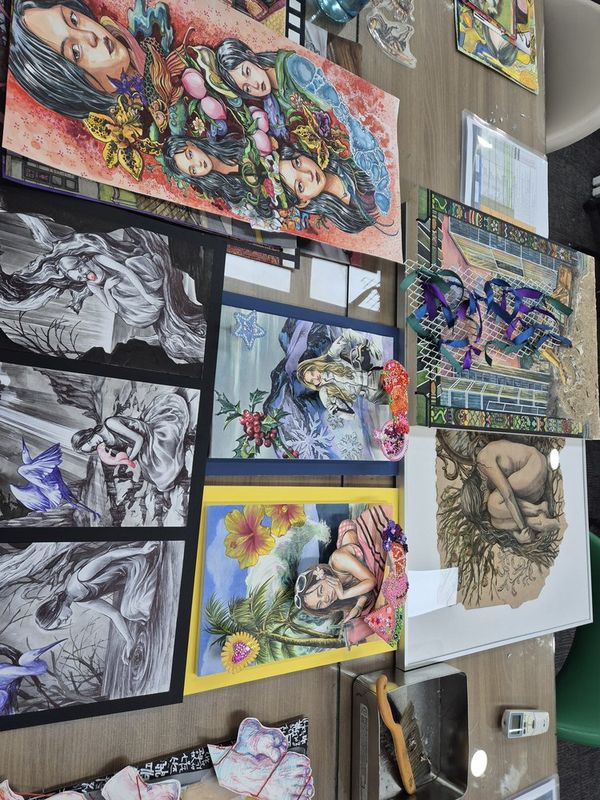
RISD’s fine art programs — Painting, Sculpture, Printmaking, Photography, and others — are built on a deep commitment to studio practice and material knowledge. RISD treats fine art as a rigorous discipline with its own history, logic, and standards. Students are expected to develop strong technical foundations before exploring conceptual territory.
Key Insight: RISD
Frequently Asked Questions
Q1. What are the key differences between RISD and PARSONS?
The Providence environment is quieter and more insular than New York, which RISD students tend to experience as either a strength or a limitation depending on their temperament. The school’s culture is studio-first — the expectation is that students spend the majority of their time making things and talking about what they make.
Parsons Fine Art: What You Need to Know
Parsons’s Fine Arts program is more explicitly conceptual and more embedded in contemporary art discourse. Located in New York, it benefits from proximity to galleries, museums, and the international art market. Parsons fine art students are expected to engage with current critical and cultural conversation about what art is and what it does.
The program is more interdisciplinary than RISD’s fine art tracks — students are encouraged to move across media and to situate their practice within broader cultural and theoretical frameworks. For students drawn to contemporary art’s intersection with politics, identity, and culture, Parsons offers a richer theoretical environment.
RISD vs Parsons Fine Art: Key Differences
| Factor | RISD | Parsons |
| Approach | Material rigor, studio-first | Conceptual, critical theory, interdisciplinary |
| Location | Providence, RI | New York City |
| Art Market Access | Strong alumni network | Direct NYC gallery/museum proximity |
| Media Emphasis | Medium-specific depth | Cross-media exploration |
| Critical Framework | Studio-based critique culture | Theory-informed critical discourse |
| Acceptance Rate | ~20% overall | ~52% overall |
| Portfolio Emphasis | Material development, personal voice | Concept, contemporary art awareness |
Which Is Better for Fine Art: RISD or Parsons?
Choose RISD if:
You want to develop deep technical skills in a specific medium alongside a strong personal creative voice. You value a studio culture that prioritizes making over talking. You are drawn to painting, printmaking, sculpture, or photography as disciplines with their own material logic — and you want to master that logic before engaging with broader theoretical frameworks.
Choose Parsons if:
You are drawn to contemporary art discourse — to work that engages with current cultural, political, and social questions. You want to be in New York City and benefit from direct access to galleries, museums, and the international art world infrastructure. You prefer a more interdisciplinary and theoretically rich environment, and you are more interested in what art means than in the mastery of a specific medium.
A Note for Korean Students
공식 정보: RISD 공식 입시 안내
Korean fine art students often find RISD’s material rigor familiar — it resonates with aspects of Korean art education’s emphasis on technical development. The adjustment at RISD is typically in the direction of creative openness and personal voice rather than technique. At Parsons, the adjustment is often in the direction of theoretical confidence and comfort with contemporary art discourse. Royal Blue prepares students for both adjustments as part of the preparation process.
Same Major, Opposite Financial Structures
Royal Blue has recorded 1,099 acceptances across 95 schools between 2009 and 2026. These two schools appear at similar volume — 68 and 63 — which makes the comparison clean, and the result unusually stark.
| School | Acceptances | Awarded | Award rate | Average award |
|---|---|---|---|---|
| Otis | 38 | 31 | 82% | $63,935 |
| MICA | 64 | 51 | 80% | $54,290 |
| SAIC | 81 | 56 | 69% | $46,775 |
| Parsons | 63 | 38 | 60% | $53,116 |
| SVA | 140 | 41 | 29% | $58,944 |
| RISD | 68 | 4 | 6% | Not reported (n=4) |
Source: Royal Blue admissions records, 1,099 acceptances across 95 schools, 2009–2026. Initial award letters, applied against tuition. Overall award rate 41.3% (454 awards, $23,746,972 total, $52,306 average). Award rates cover all majors at each school.
Parsons is ten times more likely than RISD to attach money to an offer. Sixty-four of our 68 accepted RISD students received nothing. The four who did are too small a sample to average, so we publish no average figure for RISD. For an individual applicant, though, the instruction is identical to a school that gives nothing: assume full cost.
One limit worth stating: these rates cover all majors at each school, not fine art alone. We do not hold school-by-major funding figures and will not construct them by splitting 148 fine-art acceptances across many institutions.
Fine Art Is the Hardest-Funded Major We Track
The school-level gap above sits on top of a major-level one, and the two compound.
| Major | Acceptances | Award rate | Average award |
|---|---|---|---|
| Animation | 43 | 58% | $56,140 |
| Communication Design | 95 | 54% | $53,490 |
| Graphic Design | 211 | 36% | $48,591 |
| Fine Arts | 148 | 26% | $58,451 |
Source: Royal Blue admissions records, 2009–2026. Major labels normalised. Initial award letters.
Fine arts sits last on frequency and second on size — 26% of our fine-art acceptances came with money, but those awards averaged more than every design category. Rare and large.
Now put the two layers together. A fine-art applicant whose list is RISD plus a few similar schools has stacked a 26% major on a 6% school. That is not an argument against RISD — it is an argument about what else has to be on the list, and it is the most common structural error we see in fine-art applications.
How to Build the List
RISD if your practice is material-led and you want the depth, the facilities and the international name. Budget it as full cost and treat any award as an unlikely bonus.
Parsons if you want fine art situated in social and cultural context, in New York — and if funding has to be part of the plan. At 60% it is the most likely of the three main New York options to attach money to an offer: Parsons 60%, Pratt 39%, SVA 29%.
Both, if the work genuinely fits both — and then at least one school above the 60% line beside them. MICA at 80% and SAIC at 69% are the two our records point to most consistently, and both are serious fine-art destinations rather than consolation choices.
And compare the letters, not the reputations. Subtract each award from that school’s published tuition, add housing, materials and living costs, and compare the final totals. Providence and Manhattan differ substantially on that second half, and fine-art materials are a real line item rather than a rounding error.
The standing caution: an award rate is not an admission rate and not a measure of program quality. RISD’s 6% says nothing about its studios or its teaching, and fine arts’ 26% says nothing about the value of studying fine art. These describe how schools distributed their own money among students we worked with — a planning input, not a ranking.
Frequently Asked Questions
Which school has better MFA preparation for fine art students?
Both schools produce students who go on to strong MFA programs. RISD’s studio-first culture often produces students with stronger material foundations. Parsons’s theoretical framework often produces students who are more immediately fluent in contemporary art discourse. Both are assets at the MFA level.
Is fine art a viable career path for Korean students?
Fine art careers require building an independent creative practice alongside other income sources — teaching, residencies, commercial work. Both RISD and Parsons provide the foundation for that kind of career. The question of viability depends on the individual student’s commitment, ambition, and willingness to build a multifaceted creative career.
How does Parsons’ two required essays evaluate fine art applicants?
Parsons’ two required essays are the same for all applicants. For fine art applicants, the essays’s open-ended creative prompt is an opportunity to demonstrate conceptual thinking and visual intelligence — exactly the qualities Parsons’s fine art program values.
Which school has more international fine art students?
Both schools are highly international. RISD has a large Korean and Asian student community. Parsons’s New York environment is among the most internationally diverse of any art school in the country.
How do I know if I’m better suited for RISD or Parsons fine art?
The most reliable indicator is how you experience your own creative practice. If you work best through sustained material engagement — through the physical process of making — RISD is likely the better fit. If you work best through ideas and cultural engagement — through connecting your practice to larger discourses — Parsons is likely the better fit. Royal Blue helps students make this assessment honestly during the consultation process.