QUICK ANSWER
RISD offers studio depth and craft foundation; CalArts offers authorial freedom and asks you to arrive with a position. For fine art specifically the funding shape has an unusual consequence. Fine arts has the lowest award rate of any major in Royal Blue’s records — 39 of 148 acceptances, 26% — but the second-highest average award at $58,451. Rare and large. At RISD the pattern is more extreme still: 4 of 68 accepted students received awards, averaging $103,760. That combination has a specific strategic implication — a fine art applicant should apply to more schools than a design applicant, not fewer, because each application is a low-probability draw with a large payoff.
RISD and CalArts represent two of the most distinct fine art educational cultures in the United States — and choosing between them is one of the clearest self-knowledge tests a prospective fine art student can face. This RISD vs CalArts fine art comparison explains what each school develops in its students and which environment is likely to produce the artist you want to become.
RISD Fine Art: What You Need to Know
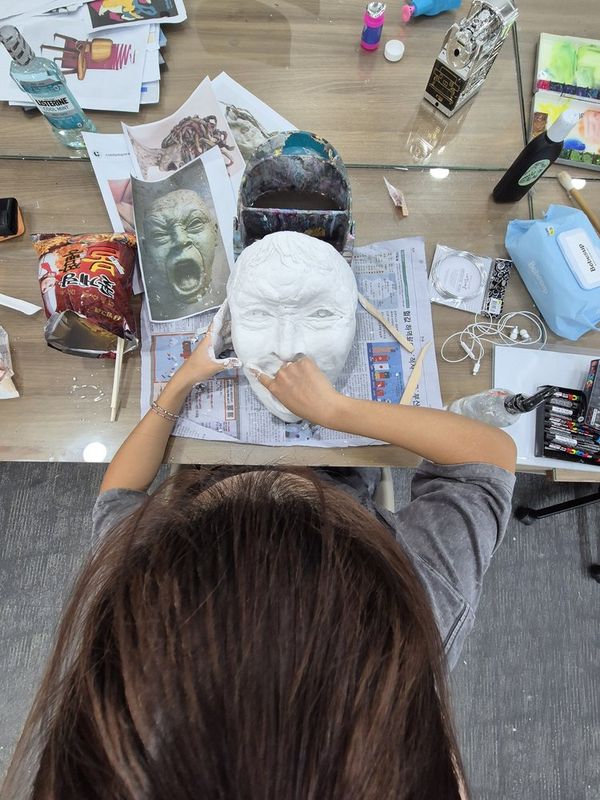
RISD’s fine art programs are built on a commitment to material knowledge and studio practice. Students spend significant time developing technical skills in specific media — painting, sculpture, printmaking, photography — before and alongside their conceptual development. The critique culture at RISD is rigorous and centered on the work itself: what it does, how it does it, and what decisions produced it.
Key Insight: CalArts
Frequently Asked Questions
Providence’s quieter environment produces a studio culture that is genuinely focused on making. RISD fine art students are expected to be in the studio — producing, experimenting, failing, revising. The school’s institutional culture values craft and sustained practice as the foundation of serious creative work.
CalArts Fine Art: What You Need to Know
CalArts’s fine art programs — including its Art program — operate within a radically self-directed studio culture. There are no required courses beyond a minimal core, and students are expected to develop their own practice with the guidance of a faculty of working artists. CalArts treats art education as a process of becoming rather than a curriculum to be completed.
The critical framework at CalArts is explicitly theoretical — students are expected to engage with contemporary art discourse, critical theory, and the institutional context of art production. CalArts fine art is not primarily about learning to paint or draw — it is about developing a critical creative practice in dialogue with the broader art world.
RISD vs CalArts Fine Art: Key Differences
| Factor | RISD | CalArts |
| Core Approach | Material rigor, studio practice | Self-directed, critical theory, conceptual |
| Required Curriculum | Structured foundation + studio track | Minimal requirements, maximum autonomy |
| Critique Culture | Work-focused, rigorous | Discourse-heavy, theoretical |
| Location | Providence, RI | Valencia, CA (near LA) |
| Art World Access | Strong alumni network | LA/NYC gallery culture proximity |
| Acceptance Rate | ~20% overall | ~26% overall |
| Best For | Material, craft-driven practitioners | Conceptual, theory-engaged artists |
Which Is Better for Fine Art: RISD or CalArts?
Choose RISD if:
You want to develop deep technical skills in a specific medium alongside a strong personal voice. You thrive in structured environments with clear expectations. You are a maker at heart — someone who thinks through materials and process. You want a fine art education that will give you technical mastery as well as conceptual development.
Choose CalArts if:
You are already self-directed and want the freedom to develop your practice on your own terms. You are deeply engaged with contemporary art discourse and theoretical frameworks. You do not want a prescribed curriculum — you want to determine your own educational path with faculty guidance. CalArts is for students who already know they are artists and want the freedom to become the specific artist they need to be.
A Note for Korean Students
공식 정보: RISD 공식 입시 안내
The choice between RISD and CalArts for fine art is one of the most important self-knowledge decisions a Korean student can make. Korean students who have been trained in technically rigorous academic art environments often find RISD’s structure familiar and productive. Students whose creative instincts are genuinely unconventional — who have always felt constrained by structured curricula — often find CalArts transformative. Royal Blue helps students make this assessment honestly during the consultation process.
Fine Art Funding Is Rare and Large — and That Changes Your Strategy
Royal Blue has recorded 1,099 acceptances across 95 schools between 2012 and 2026. Fine arts behaves differently from every design major in our archive, and the difference has a practical consequence most guides do not draw out.
| Major | Acceptances | Awarded | Award rate | Average award |
|---|---|---|---|---|
| Animation | 43 | 25 | 58% | $56,140 |
| Communication Design | 95 | 51 | 54% | $53,490 |
| Graphic Design | 211 | 77 | 36% | $48,591 |
| Illustration | 102 | 33 | 32% | $42,373 |
| Fine Arts | 148 | 39 | 26% | $58,451 |
Source: Royal Blue admissions records, 1,099 acceptances across 95 schools, 2012–2026. Major labels normalised. Initial award letters. Overall award rate 41.3% (454 awards, $23,746,972 total, $52,306 average).
Fine arts sits last on frequency and second on size. Just over a quarter of our fine art acceptances came with money, but those awards averaged more than every design category on the table. This is a 148-case sample, so the pattern is well evidenced rather than a small-number effect.
Here is the strategic implication. A graphic design applicant faces a 36% chance of a moderate award — an outcome you can plan around, and one that does not change much whether you apply to six schools or ten. A fine art applicant faces a 26% chance of a large one. Low probability with a high payoff argues for more attempts, not fewer.
That is the opposite of what most Korean families do. The instinct when funding looks unlikely is to narrow the list to schools that feel attainable — but with fine art, narrowing reduces the number of draws without improving any individual odds.
RISD Is the Extreme Case of That Pattern
Whatever fine art does as a major, RISD does more of it.
| School | Acceptances | Award rate | Average award |
|---|---|---|---|
| MICA | 64 | 80% | $54,290 |
| SAIC | 81 | 69% | $46,775 |
| Otis | 38 | 82% | $63,935 |
| CalArts | 15 | sample too small | sample too small |
| RISD | 68 | 6% | $103,760 |
Source: Royal Blue admissions records, 1,099 acceptances across 95 schools, 2012–2026. Award rates cover all majors at each school; we do not hold school-by-major funding figures.
RISD is the fine-art pattern taken to its limit — 6% frequency with our largest average award anywhere. CalArts we cannot speak to on funding: 15 acceptances is too small a base for a reliable rate, and that count reflects our applicant pool rather than CalArts’ difficulty.
Apply to RISD if the work fits — but treat it as one draw among several, not as the plan. Sixty-four of our 68 accepted RISD students received nothing, and MICA at 80% or SAIC at 69% belongs on the list beside it precisely because fine art needs more draws.
One Portfolio Will Not Serve Both
If applying broadly is the strategy, the cost of that strategy has to be understood: these two schools ask for different work, and CalArts says so explicitly.
CalArts names figure drawing, still life and generic class assignments as material to leave out unless it reveals a personal or unusual approach. It welcomes sketches and works-in-progress, refuses SlideRoom, PDFs and external links entirely, and requires a video introduction plus an artist statement of 500 to 1,000 words. Each programme needs its own application and fee.
For a Korean fine art applicant with sustained observational training, that single instruction reshapes the entire submission. Plan two selections from a larger body of work, and budget the video and statement as real tasks rather than formalities.
How to Decide
RISD if your fine art practice rests on sustained craft and you want depth, resources and the international name. Budget it at full cost — the 6% is not something to plan around.
CalArts if you already have a position and personal work you can talk about on camera. Its process selects for artistic stance rather than demonstrated technique.
And apply wider than you would for design. With fine art at 26% and awards averaging $58,451, more applications is the rational response to the shape of the odds — provided each one is a school where the work genuinely fits.
The standing caution: an award rate is not an admission rate and not a measure of program quality. Fine arts’ 26% says nothing about the value of studying fine art, and RISD’s 6% says nothing about its studios. These describe how schools distributed their own money among students we worked with — a planning input, not a ranking.
Frequently Asked Questions
Which school produces better-known fine art alumni?
Both schools have produced significant fine art alumni. CalArts has a particularly strong reputation in the contemporary art world, having trained artists who have shaped the development of conceptual, performance, and video art. RISD’s alumni are strongly represented across painting, sculpture, and craft-based practices.
Is CalArts too unstructured for students who need guidance?
CalArts’s self-directed model is genuinely challenging for students who need external structure to thrive. Students who succeed at CalArts are typically those with a strong internal drive and a clear sense of their own creative direction. Students who need more structured guidance often find RISD’s model more productive.

How does the portfolio review differ between RISD and CalArts for fine art?
RISD’s portfolio review emphasizes sustained studio development, technical quality, and personal creative voice. CalArts’s review emphasizes creative risk-taking, conceptual ambition, and evidence of a genuine artistic practice. Both are looking for authenticity, but they define it differently.
Can a student with conventional technical skills get into CalArts fine art?
Technically conventional but conceptually adventurous students can succeed at CalArts. Technically excellent but conceptually conventional students typically do not. CalArts is specifically looking for creative ambition and unconventional thinking.
Which school is better preparation for graduate fine art programs?
Both schools produce students who go on to strong MFA programs. RISD graduates typically arrive at MFA programs with stronger technical foundations. CalArts graduates typically arrive with stronger theoretical fluency and a more developed critical practice. Both are assets at the graduate level.