Quick Answer: Korean hanok (한옥) traditional architecture is one of the most strategically powerful portfolio subjects available to Korean design applicants — but only when engaged through principles rather than decoration. Spatial logic, passive environmental systems, material traditions, and cultural meanings each offer substantive design investigation. Translated into industrial design, architecture, or graphic design work, deep hanok engagement consistently distinguishes Korean applicants at RISD, Parsons, Harvard GSD, and peer programs. Royal Blue Art & Design in Apgujeong, Seoul has guided Korean students through this approach for 19+ years.
| Grade/Year | Portfolio Focus | Hours/Week | Key Milestone |
|---|---|---|---|
| 9th Grade | Foundation: drawing, color theory, diverse media | 5-8 | Build foundational skills |
| 10th Grade | Explore specific interests, life drawing, mixed media | 8-12 | Identify creative direction |
| 11th Grade | Develop personal voice, ambitious projects | 12-18 | Build 15+ strong pieces |
| 12th Grade (Fall) | Curate portfolio, write essays, research schools | 15-20 | Submit applications |
| Summer (any) | Art camps, intensive studios, personal projects | 20-30+ | Accelerate development |
Frequently Asked Questions
Q1. When should I start building my art school portfolio?
The ideal timeline begins in 9th or 10th grade (age 14-15) for students planning to apply to US art schools. Early preparation allows genuine artistic development rather than rushed portfolio manufacturing. 9th grade: explore diverse media, develop foundational skills, take drawing classes. 10th-11th grade: identify your creative direction, develop more ambitious projects, research programs. 12th grade: finalize portfolio, write personal statement, apply. Students who start in 12th grade often submit technically polished but artistically underdeveloped work.
Q2. How many pieces should be in an art school portfolio?
Most programs request 12-20 pieces, with sweet spots around 15 works. Quality is more important than quantity—14 exceptional pieces are more impressive than 20 mediocre ones. Include only your best work; padding with weaker pieces dilutes the overall quality impression. Many programs also specify proportion of required pieces (some works must be from direct observation, for example). Read each school’s portfolio guidelines carefully, as requirements vary significantly by program and institution.
Q3. What types of artwork should I include in my portfolio?
A strong portfolio typically includes: direct observational drawing (life drawing, still life, landscape)—which demonstrates fundamental skill; work in multiple media (drawing, painting, collage, digital, photography, 3D) showing versatility; your strongest conceptual or thematic work; process documentation (sketches, iterations) for 1-2 projects; and a few pieces in your developing personal style. Avoid submitting only one type of work—even if you’re applying to Illustration, showing painting and life drawing demonstrates broader artistic capacity.
Q4. Should I include unfinished work in my portfolio?
Unfinished work can be valuable if it reveals your thinking process more clearly than finished work. A sketch that shows dynamic gestural thinking may be stronger than a finished, tightened version of the same image. The key question is: does this piece contribute to a positive overall impression, or does it raise doubts? Process documentation (sequential sketches showing how a piece developed) is different from simply submitting incomplete work—the former demonstrates thinking, the latter can suggest poor time management.
Q5. How important are observational drawing skills for art school?
Observational drawing—drawing from direct observation of figures, objects, landscapes—remains fundamental at virtually all art schools. Even programs with strong digital or conceptual emphases expect applicants to demonstrate they can observe and render the visual world accurately. Life drawing is particularly important: figure drawing classes appear at every major art school. Students who neglect observational drawing in favor of exclusively digital or stylized work often struggle in first-year programs. Take life drawing classes throughout high school.
Q6. How should I document and photograph my portfolio work?
Portfolio documentation significantly affects how work is perceived. For 2D work: shoot in natural light or even, non-directional artificial light; ensure the image is straight (not skewed); show the full work without cropping; shoot on a neutral background; crop out any table edges or props; use a camera (not phone camera) for large works. For 3D work: multiple views from different angles; neutral background; scale reference if helpful. For digital work: submit final files directly rather than photographing screens. Poor photography of strong work is a common application mistake.
Q7. What is a ‘home test’ and how should I approach it?
A home test is a creative assignment given to art school applicants as part of the application. RISD’s famous ‘bicycle’ drawing and their abstract geometric prompt are examples. Approach the home test as a creative challenge, not a technical exercise—programs want to see how you think and respond to creative constraint, not whether you can execute the most technically polished version. Read the prompt carefully for specified constraints; beyond those, interpret as broadly and originally as possible. The most memorable responses are genuinely surprising.
Q8. How do art schools evaluate portfolio work from Korean preparation academies?
US admissions committees regularly review portfolios from Korean art preparation academies (입시 미술학원). They have developed familiarity with both the strengths (strong technical foundation, disciplined drawing skills) and weaknesses (formulaic compositions, lack of personal voice) of Korean academy preparation. Portfolios that transcend the academy template—showing genuine personal creative interests, unexpected conceptual choices, or distinctive visual language—stand out strongly. Include work from outside your academy preparation that reflects your authentic creative interests.
Q9. What should I include in my artist statement for art school applications?
An artist statement for art school applications should: explain your creative motivations authentically and specifically; describe what questions or ideas drive your work currently; connect your past development to your future aspirations; reference specific influences (artists, experiences, cultural backgrounds) that inform your work; and demonstrate that you’ve researched the specific program and can articulate why it fits your trajectory. Avoid vague generalizations (‘I’ve always loved art’); be specific about your current creative preoccupations and what you want to develop further.
Q10. How do digital portfolios differ from physical ones?
Most art school applications now use digital portfolio submission through platforms like SlideRoom, Acceptd, or the school’s own portal. Digital portfolios: must be high-resolution (minimum 1500px longest side, ideally 2000+); should be in appropriate file formats (JPEG for still images, PDF for process documentation, video for time-based work); require accurate color profiles; and benefit from thoughtful sequencing since reviewers often view quickly. A well-presented digital portfolio can exceed a physical portfolio in impact if the documentation is high quality. Include any 3D or installation work through multiple-view photography.
Korean design students applying to US programs have a genuine competitive advantage that most never fully use: direct access to one of the world’s most sophisticated architectural traditions. Hanok architecture — developed over centuries to solve real problems of climate, material, social structure, and spiritual life — contains design principles that remain urgently relevant today. At Royal Blue Art & Design in Apgujeong, Seoul, we’ve watched hanok-informed portfolios open doors at RISD, Parsons, and top architecture programs — and we’ve watched shallow hanok work close them.
This guide explains what separates strong hanok portfolio work from weak hanok portfolio work, and how to build the former.
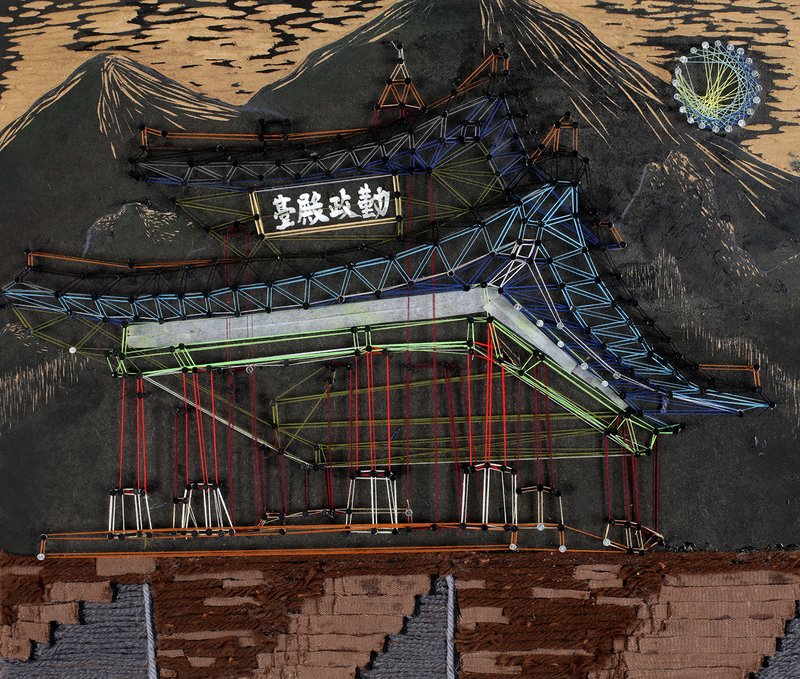
Hanok Core Principles Worth Investigating
The most common hanok portfolio mistake is drawing hanok exteriors — producing technically accomplished renderings of tiled roofs and wooden columns that demonstrate skill but reveal no design thinking. What admissions reviewers are looking for is understanding of underlying principles, and hanok offers eight that translate powerfully into contemporary design work.
The inside-outside boundary in hanok is fundamentally more permeable than in Western architecture. Daecheong (대청) halls, toenmaru (툇마루) verandas, and madang (마당) courtyards create a spatial continuum rather than a hard separation — a concept directly applicable to contemporary product design, interior systems, and architectural programming. The madang as organizing principle works differently than Western concepts of courtyard: it manages light, airflow, sightlines, and circulation simultaneously, functioning as a dynamic regulator rather than a passive void.
Ondol floor heating (온돌) doesn’t just change how a room is warmed — it entirely restructures the relationship between body and space, between furniture and floor, between sitting and standing culture. This is rich territory for industrial and interior designers. The structural logic of roof forms — the upward curve of eaves — is not aesthetic preference but functional engineering: managing rainwater dispersal, regulating solar gain by season, and distributing structural loads. Understanding this changes what a designer can do with the form.
Natural material integration in hanok — wood, earthen walls (황토), hanji paper (한지), stone — follows each material’s properties rather than imposing a unified surface treatment. The joinery system (결구), which achieves structural integrity without nails through interlocking wood members, is a direct precedent for contemporary modular and demountable design. Seasonal adaptability — the same structure made radically open in summer and tightly insulated in winter through the same architectural elements — is a model for contemporary passive environmental design. Finally, hanok’s integration with landscape through the baesanimsu (배산임수) siting principle represents a design philosophy about the relationship between built form and terrain that remains sophisticated by any standard.
A portfolio that investigates one of these principles deeply — tracing it through research, personal observation, and design translation — is substantially stronger than one that surveys all eight superficially.
Hanok for Industrial Design Portfolios
Industrial design programs — RISD ID, Pratt ID, ArtCenter Product Design — are particularly receptive to hanok-informed work when the translation is rigorous. The key word is translation: not illustration of hanok, but extraction of principles and their application to contemporary product problems.
The ondol system offers a model for rethinking radiant heating at the product scale — floor-based, body-proximate, ambient rather than directed. A designer who understands how ondol changes the experience of a room can ask genuinely new questions about domestic heating products. Hanok joinery offers a structural vocabulary for furniture and modular systems that achieve strength through geometry rather than fasteners — a direction with clear relevance to sustainable, demountable design. The hanji-wood-earthen material palette, understood in terms of haptic qualities and aging behavior rather than visual appearance, provides a framework for contemporary material exploration that goes beyond surface texture.
Hanok’s approach to small-space efficiency — the same room serving as bedroom, living room, and workspace through flexible furnishing rather than fixed program — is directly relevant to contemporary micro-housing and compact living product challenges. The seasonal transformation mechanisms (folding and sliding door systems that radically change spatial boundaries) provide a design vocabulary for adaptable products and environments. Each of these directions requires genuine understanding of hanok principles to execute credibly — and that depth of understanding is precisely what reviewers are evaluating.
Hanok for Architecture Portfolios
Architecture programs — RISD Architecture, Harvard GSD, SCI-Arc, Columbia GSAPP, Pratt Architecture — value students who bring substantive cultural architectural knowledge to contemporary design questions. For Korean applicants, hanok offers exactly this: a sophisticated traditional system with direct relevance to the field’s most pressing concerns.
Hanok’s passive environmental systems — orientation strategy, roof overhang calculation, courtyard microclimate management, earthen thermal mass — represent pre-industrial solutions to problems that contemporary sustainable architecture is still solving. A portfolio project that genuinely engages these systems, rather than stylistically referencing hanok forms, can demonstrate environmental design intelligence at a high level. The tension between hanok preservation and contemporary urban development — active in Seoul’s Bukchon, Ikseon-dong, and Jeonju — offers rich territory for urban design and adaptive reuse projects with real analytical depth.
The madang principle, applied to contemporary residential or public space design, raises genuine questions about interior-exterior relationships, community and privacy thresholds, and spatial hierarchy that go beyond stylistic gesture. Hanok’s material honesty — each material used according to its properties, no surface disguised — provides a design philosophy that connects directly to contemporary tectonics discourse. Students who can articulate these connections fluently, in both portfolio work and interview conversation, carry a distinct advantage.
Hanok for Graphic and Communication Design Portfolios
Graphic design applications require more intentional translation of hanok material, since the connections are less direct. The risk is decorative use of hanok imagery without design purpose — and experienced reviewers identify this immediately. Strong graphic design work using hanok material translates spatial principles into 2D design principles.
Hanok’s proportional systems and use of negative space offer genuine frameworks for layout and publication design — not as stylistic homage but as a structural logic for organizing visual information. Wayfinding and environmental graphic systems designed for hanok villages (Bukchon, Jeonju, Andong Hahoe Village) present real design problems: how to orient contemporary visitors through traditional spatial sequences while respecting the character of the environment. Brand identity systems for contemporary Korean businesses drawing on hanok heritage require genuine understanding of what hanok represents culturally to do well. Typography exploration informed by the geometric logic of hanok structural elements — the proportions of column, beam, and bracket — can generate original formal language rather than surface decoration. In every case, the test is whether the hanok reference serves a design intention or merely signals Korean cultural content.
Authentic Personal Connection: Why It Makes the Difference
Admissions reviewers at top design programs read hundreds of portfolios annually. They recognize the difference between hanok knowledge acquired from research and hanok understanding formed through personal experience — and that difference shows in the work. Personal connection is not optional for strong hanok portfolio work; it is what separates distinctive work from competent work.
Family connection to a specific hanok — grandparents’ village home, an ancestral house still in the family, a specific building you visited repeatedly as a child — provides irreplaceable material. Not because sentimental content makes good design, but because specific personal memory generates specific observations that generic research cannot produce. The quality of light in a particular ondol room at a specific time of day. The way a specific madang felt different in summer and winter. The exact texture of a hanji screen that you touched as a child. These specifics, translated into design thinking, create work that is genuinely yours and genuinely unrepeatable.
Students without strong family hanok connections can build authentic engagement through intentional visits. Bukchon Hanok Village in Seoul, Jeonju Hanok Village, and Andong Hahoe Village are all accessible for day visits. But visiting as a designer — observing light, air movement, spatial sequences, material behavior, the bodily experience of moving through spaces at different scales — produces different material than visiting as a tourist. The notebook and camera you bring to a hanok research visit should be tools of design investigation, not documentation.
Research Approach: Going Beyond the Tourist Guide
The depth of hanok research visible in portfolio work directly correlates with review outcomes. Generic hanok content — the kind of information available in any tourism brochure — produces generic work that signals shallow engagement. Substantive research produces work that demonstrates genuine intellectual investment.
Regional variation is a productive starting point: hanok in Gyeongbuk (Andong), Jeonbuk (Jeonju), and Seoul developed differently in response to different climate conditions, terrain, available materials, and social structures. Understanding these differences — and why they exist — demonstrates analytical thinking about architecture. Contemporary Korean architects working with traditional principles (Seung H-Sang, Cho Byoungsoo, and others) offer models for how hanok knowledge translates into contemporary practice. Studying their work reveals what substantive translation looks like at a professional level.
Specific technical knowledge matters: understanding how the joinery system achieves structural integrity, how ondol channels heat through floor systems, how the roof structure distributes load to columns — this kind of knowledge transforms a designer’s ability to think with hanok rather than just about it. Primary source material, where accessible, is more valuable than secondary synthesis: historical construction manuals, architectural historians’ analyses rather than popular accounts, the buildings themselves rather than photographs of them.
Avoiding the Clichés: What Reviewers Dismiss Immediately
Certain hanok portfolio approaches appear so frequently — and signal so clearly the absence of genuine engagement — that experienced reviewers dismiss them within seconds. Identifying and avoiding these patterns is as important as developing strong positive work.
Tourist-perspective exterior scenes — atmospheric renderings of tiled roofs against sky, romanticized village scenes — demonstrate observation skill but no design thinking. Decorative application of hanok visual elements (roof curves, lattice patterns, tile textures) without understanding what they mean structurally or culturally is the most common weak approach, and the most transparent. Conflating palace architecture (Gyeongbokgung, Changdeokgung) with residential hanok demonstrates fundamental misunderstanding of the tradition. Romanticized representation that ignores the social complexity of hanok — the hierarchies embedded in spatial organization, the gendered division of space between anchae and sarangchae — produces work that is historically naive. Generic “Korean traditional” signaling without specificity — hanok as cultural shorthand rather than specific architectural investigation — reads as opportunistic rather than genuine.
The test is direct: are you using hanok as a design thinking tool, or as a cultural identity signal? Reviewers can tell. The former produces work worth making; the latter produces work worth skipping.
Frequently Asked Questions
Do I need an architecture background to use hanok in my portfolio?
No formal architecture training is required. Hanok engagement through research and personal observation is available to any designer regardless of academic background. For architecture program applications specifically, understanding of structural and environmental systems will be evaluated more rigorously — but this knowledge is acquirable through focused study and site visits rather than formal coursework.
Is hanok too niche a subject for US programs?
No — specificity is typically an advantage, not a liability. US design programs actively value applicants who bring substantive cultural knowledge to their work, and they encounter far too many portfolios that could have come from anywhere. Hanok work that demonstrates genuine understanding of a sophisticated architectural tradition stands out positively against the generic international content that dominates the applicant pool. The risk is not excessive specificity; it’s insufficient depth.
Can hanok work include interior design elements?
Yes, and productively. Ondol culture’s floor-based spatial organization, the transformation of interior space through flexible furnishing systems, the material palette of wood and hanji in interior applications, and the relationship between anchae (안채) spatial sequences and domestic life all offer substantive territory for interior and furniture design work. The traditional Korean room’s capacity to function as bedroom, living room, and workroom through reconfiguration rather than dedicated programming is a design intelligence that remains relevant to contemporary small-space living challenges.
Should I visit specific hanok before making portfolio work?
Strongly recommended. Direct experience changes the quality of work in ways that no amount of research can substitute. Bukchon Hanok Village in Seoul, Jeonju Hanok Village, and Andong Hahoe Village are the most accessible options, each offering different types of hanok in different settings. Visit with a designer’s questions — about light, air, material behavior, spatial sequence, the bodily experience of scale — rather than a tourist’s camera. The observations produced by intentional design research visits are the raw material of strong portfolio work.
Beyond RISD and Parsons, which programs respond well to hanok-informed portfolios?
Harvard GSD, SCI-Arc, Columbia GSAPP, Pratt Institute (both architecture and industrial design), ArtCenter College of Design, Cooper Union, and SVA all respond positively to portfolios demonstrating substantive engagement with cultural architectural traditions. Programs with strong sustainability or social design emphases are particularly receptive to hanok’s environmental and community-organization dimensions. The specific program matters less than the quality of the engagement — strong work translates across institutional cultures.
How do I translate hanok principles into a design project without it looking like cultural tourism?
The distinction is between referencing hanok and thinking with hanok. Cultural tourism portfolios illustrate hanok — they render tiled roofs, trace lattice patterns, reproduce traditional proportions. Design-thinking portfolios extract a specific principle and apply it to a contemporary problem: using the madang’s microclimate logic to design a contemporary urban courtyard system, applying ondol’s radiant floor logic to a compact heating product, deriving a modular furniture system from joinery geometry. The question to ask about every design decision is: “does this come from understanding the principle, or from copying the appearance?” Reviewers at top programs can identify the difference in seconds.
Can non-Korean students use hanok in their design portfolios?
Yes, provided the engagement is honest about its position. A non-Korean student investigating hanok as an outside observer — transparent about that position in their artist statement — can produce credible work. What weakens any hanok portfolio work, regardless of the applicant’s background, is claimed intimacy that doesn’t exist. The honest framing of “I encountered this architectural tradition through research and site visits, and it raised questions I’m investigating” is more credible than performed familiarity. Depth of genuine investigation matters more than cultural proximity to the material.
What is the difference between hanok and traditional Korean palace architecture, and does it matter for portfolio work?
It matters significantly — and conflating them is one of the errors reviewers notice immediately. Palace architecture (궁궐 건축) — Gyeongbokgung, Changdeokgung, Changgyeonggung — represents state power, ceremonial function, and concentrated resources: elaborate bracket systems, large-scale construction, monumental spatial sequences. Residential hanok developed different principles in response to different constraints: domestic life, seasonal climate management, available local materials, social organization within the household. The spatial logic, material palette, and design intelligence are different. Portfolio work using palace imagery as shorthand for “Korean traditional architecture” misrepresents both traditions and signals limited research to anyone familiar with Korean architecture.
How should hanok research be documented in a portfolio?
Research documentation in portfolio work should show design thinking in process, not research completeness. Effective approaches: sketchbook pages showing analytical observation from site visits (light studies, spatial sequence diagrams, material texture notes), comparative analysis drawings showing how a specific hanok principle varies across regional types, process documentation showing how a research insight led to a specific design decision, annotated photographs that demonstrate what you were looking at and why. What weakens research documentation is information display without analytical framing — photographs and facts assembled without the interpretive layer that shows a designer’s mind working. The goal is demonstrating how research shaped design decisions, not proving that research was conducted.
Is hanok relevant for fashion design portfolios?
Yes, through material and structural principles rather than costume reproduction. The most common weak approach — reproducing hanbok (한복) silhouettes or applying pojagi (조각보) patchwork patterns decoratively — signals cultural identity rather than design investigation. Stronger approaches engage hanok’s material intelligence: hanji’s tensile and translucent properties translated into textile exploration, the spatial logic of layered hanok interiors translated into garment volume and layering systems, the seasonal adaptability of hanok spatial transformation translated into modular or convertible garment systems. The hanok-fashion connection requires more translation effort than architecture or industrial design, but that difficulty is itself a differentiator — few fashion portfolios engage it with genuine depth.
How many portfolio pieces should engage hanok, and how many should show other work?
No fixed ratio serves all applicants. The right proportion depends on how central hanok investigation is to your genuine design interests. If you are building a coherent body of work around traditional Korean spatial principles and their contemporary applications, a substantial majority of pieces engaging hanok can be appropriate and compelling. If hanok is one of several substantive interests, one or two strong pieces alongside other work demonstrates range without dilution. What weakens portfolios is including hanok work because it seems strategically advantageous, rather than because it represents genuine investigation — reviewers identify obligatory cultural content quickly. Include what you’ve actually investigated seriously; omit what you included for strategic reasons rather than artistic ones.
What are the most common mistakes Korean students make when including hanok in design portfolios?
Five patterns appear most frequently in portfolios that underperform. First, rendering hanok exteriors without engaging spatial or structural principles — demonstrating observational drawing skill but no design thinking. Second, applying hanok visual elements (roof curves, lattice patterns, dancheong color systems) decoratively without understanding their structural or cultural meaning. Third, conflating palace architecture with residential hanok — a fundamental category error that signals limited research. Fourth, using hanok as cultural identity shorthand — including it to signal “I am Korean” rather than because it raises design questions worth investigating. Fifth, surface-level research producing surface-level work — Wikipedia-depth knowledge of hanok is visible in the work it produces. Each of these mistakes is avoidable through the same remedy: genuine investigation of specific principles in sufficient depth to generate design questions that are authentically yours.
Next Steps
Hanok architecture is exceptional portfolio material for Korean design students — not as cultural identity performance, but as a sophisticated design tradition containing principles urgently relevant to contemporary practice. The path from “I’m Korean, so I’ll include hanok” to work that genuinely distinguishes an application runs through research depth, personal observation, and rigorous design translation. That path is available to every Korean applicant; relatively few take it seriously.
Ready to develop a hanok-informed portfolio that works? Contact Royal Blue Art & Design for a consultation.