Teaching a student to draw well is a technical challenge. Teaching a student to think like an artist is a fundamentally different task — and it is the task that Royal Blue Art & Design is most specifically designed to accomplish. This page explains what artistic thinking actually means, why it matters for US art school admissions, and how Royal Blue develops it in Korean students.
Frequently Asked Questions
Thinking like an artist does not mean being temperamental, impractical, or indifferent to the world. It means developing a specific set of cognitive habits: the ability to look at something familiar and see it freshly, to ask why something is made the way it is and imagine how it could be made differently, to connect observations from one domain to creative problems in another, and to hold multiple possibilities in mind before committing to a single resolution.
These habits of mind are what US art schools — especially RISD, CalArts, and Carnegie Mellon — are actually trying to develop in their students. Applicants who already show evidence of these habits are the ones admissions committees most want to admit.
How Royal Blue Builds Artistic Thinking
Looking Before Making
One of the first things Royal Blue instructors teach students is to develop a practice of sustained looking — not glancing, but genuinely studying objects, spaces, and images with attention and patience. Students are regularly asked to spend time with a single work of art, a single photograph, or a single corner of a room before they begin making anything. This develops the observational foundation that artistic thinking requires.
Asking Better Questions
Most students arrive at Royal Blue trained to produce answers — the right drawing, the correct composition, the expected response to a brief. Learning to think like an artist means learning to resist the first, most obvious answer and to ask better questions instead. Why is this the convention? What if the opposite were true? What would change if I approached this from a completely different material or scale?
Royal Blue critique sessions are structured to reward this kind of questioning. Instructors explicitly value the student who can articulate why they rejected their first three ideas before settling on their fourth over the student who produced the first idea without hesitation.
Making to Think, Not Just Thinking to Make
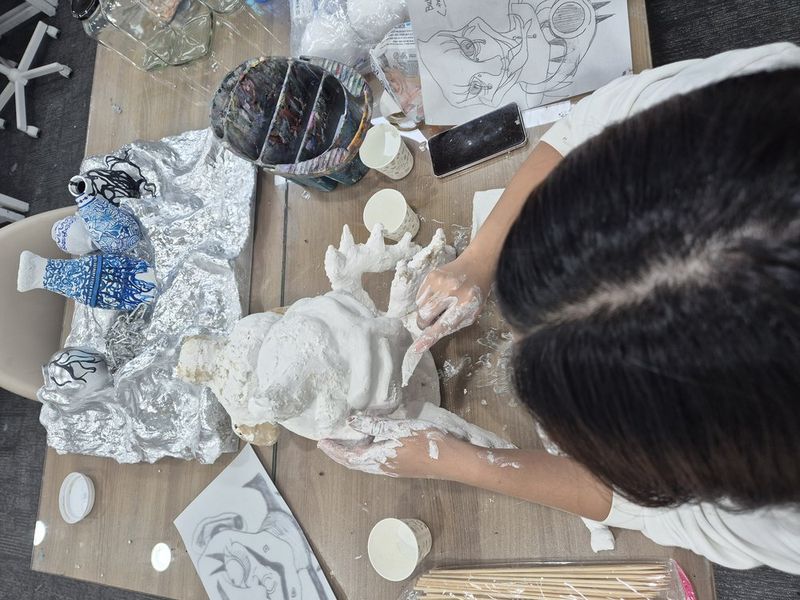
Artists do not always know what they think before they begin making. Often, the making is what produces the thinking. Royal Blue teaches students to use studio work as a genuine cognitive process — to start without knowing where they are going, to pay attention to what happens in the work, and to let unexpected results redirect the project rather than treating them as mistakes to be corrected.
This process-driven approach is the foundation of the P in the PID System, and it is one of the things that most distinguishes Royal Blue preparation from conventional Korean academy training.
Developing a Critical Vocabulary
Thinking like an artist requires language as well as vision. Students who cannot articulate what they are doing — who cannot explain a creative choice, describe the effect they were after, or analyze why something does or does not work — are at a significant disadvantage in art school environments, where critique is a central pedagogical method.
Royal Blue develops this critical vocabulary systematically. Students learn to describe visual relationships with precision, to discuss their intentions with clarity, and to engage with feedback in a way that is productive rather than defensive.
Why This Preparation Matters Beyond Admissions
Students who learn to think like artists at Royal Blue do not just produce stronger portfolios. They arrive at art school prepared for the actual culture they will encounter — a culture in which critique is continuous, assumptions are regularly challenged, and the ability to articulate your creative decisions is as important as the ability to execute them. Royal Blue alumni consistently report that their transition into US art school studio life is smoother than that of peers who arrived technically skilled but unprepared for the intellectual demands of the environment.
Frequently Asked Questions
Is artistic thinking something you are born with or something you can learn?
Both. Some students have a more naturally developed capacity for associative, non-linear thinking. But the core habits of artistic thinking — sustained attention, question-asking, process awareness, critical articulation — are learnable. Royal Blue teaches them deliberately.
How early do students start developing artistic thinking at Royal Blue?
From the first session. Even in the foundation phase, Royal Blue instructors frame technical exercises within a context of questioning and observation rather than pure replication. The habit-building begins immediately.
Does thinking like an artist conflict with academic success in Korean high school?
Not fundamentally. Many of the cognitive skills involved — sustained attention, analytical thinking, precision of expression — are also valued academically. The main adjustment is learning to apply these skills in an open-ended rather than answer-convergent context.
How do parents know if their child is developing artistic thinking?
One reliable indicator: the student starts noticing things — in their environment, in popular culture, in everyday objects — and bringing those observations back to the studio unprompted. Another indicator is that the student’s conversation about their work becomes more specific and less generic over time.
Can artistic thinking be assessed in the portfolio itself?
Yes. A portfolio that reflects genuine artistic thinking is characterized by visible decision-making, unexpected connections between pieces, evidence of experimentation and revision, and a coherent creative perspective that is not reducible to a style or a formula. These are exactly the qualities that top US art school admissions committees use to distinguish exceptional portfolios from technically proficient ones.
FURTHER READINGSeoul as a Global Design Capital: What It Means for Korean Students — Seoul’s position as a design capital shapes how Korean students are read.
Korean Art in London: What Korean Students Need to Know — Korean art in London offers another view of the same question.
Why Creative Identity Matters More Than Technical Skill — Creative identity is what admissions readers are actually looking for.