QUICK ANSWER
The decisive portfolio difference is that Parsons asks for something SCAD does not: Parsons’ two required essays, a school-specific assignment that takes one idea already in your portfolio and develops it into new work. It cannot be prepared in advance and it cannot be reused elsewhere — so a Parsons application is always a portfolio plus a separate piece of thinking. On funding the two diverge as well: in Royal Blue’s records SCAD awarded scholarship money to 34 of 42 accepted students (81%) averaging $30,221, while Parsons awarded to 38 of 63 (60%) averaging $53,116. SCAD is likelier to fund you; Parsons funds more when it does. Budget from the amount, not the percentage.
Understanding the difference between SCAD and Parsons portfolio requirements is essential for students applying to both schools — and reveals important insights about what each school is actually looking for. This SCAD vs Parsons portfolio comparison explains what each school expects and how to prepare effectively for both applications.
What Parsons Looks for in a Portfolio
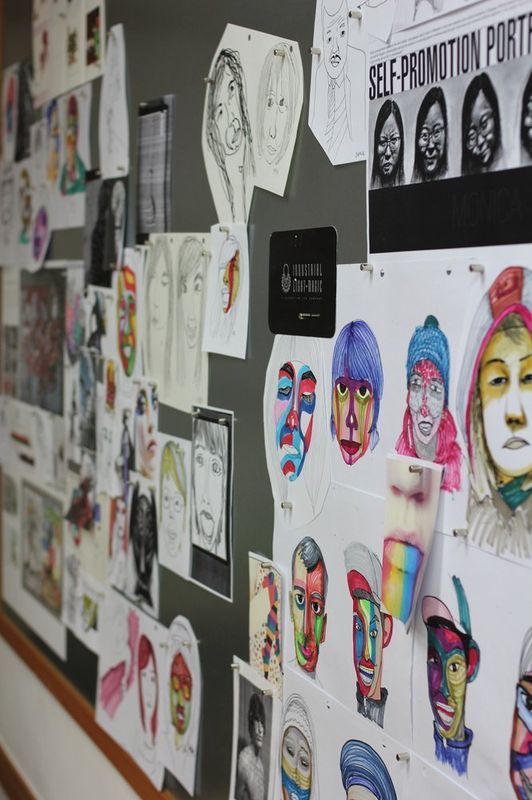
Parsons’s portfolio review emphasizes conceptual thinking, cultural awareness, and creative distinctiveness. The portfolio is not evaluated primarily on technical polish — it is evaluated on evidence that the student thinks creatively and engages with the world around them as a potential designer or artist. Work that demonstrates genuine creative investment and a clear point of view is more valuable than technically impressive but conceptually generic pieces.
Key Insight: Portfolio Preparation
Your portfolio is the single most important element of your art school application. Top programs want to see creative thinking and personal vision—not just technical execution. Start building your portfolio 12-18 months before application deadlines to allow time for genuine artistic development.
Frequently Asked Questions
Q1. What are the key differences between PARSONS and SCAD?
Alongside the portfolio, Parsons requires Parsons’ two required essays — an annual school-specific creative assignment that asks applicants to answer two prompts in writing. The essays are often a decisive factor in Parsons admissions, and students who produce a generic or poorly reasoned response consistently underperform regardless of portfolio quality.
What SCAD Looks for in a Portfolio
SCAD’s portfolio review is more program-specific and generally more accessible than Parsons’s. SCAD looks for evidence of creative potential, technical development, and genuine interest in the chosen discipline. The bar for technical quality is somewhat lower than at Parsons, and the school’s higher acceptance rate reflects a more accessible standard overall.
SCAD does not require school-specific essays equivalent to those Parsons requires. Its portfolio review focuses on the work itself — the range, quality, and creative development evident in the pieces submitted. Process documentation and sketchbooks are valued but not universally required.

SCAD vs Parsons Portfolio: Key Differences
| Factor | SCAD | Parsons |
| Portfolio Standard | More accessible, potential-focused | Higher bar, conceptual depth required |
| School-Specific Assignment | No equivalent | Parsons’ required essays (required) |
| Process Documentation | Valued but flexible | Strongly encouraged |
| Technical Bar | Developing skill acceptable | Creative thinking prioritized over polish |
| Number of Pieces | 10–20 depending on program | 12–20 depending on program |
| Written Component | Artist statement required | Challenge written reflection required |
| Acceptance Rate | ~72% overall | ~52% overall |
How to Prepare for Both Applications
Students applying to both SCAD and Parsons can use a largely consistent portfolio with some important adjustments. The core portfolio — representing genuine creative development across relevant disciplines — serves both reviews. The critical addition for Parsons is the essays response, which requires fresh development each application season and cannot be recycled from previous years.
For the written components, the tone and emphasis differ. Parsons values cultural engagement and conceptual ambition in written materials. SCAD values clarity, professional orientation, and genuine passion for the chosen discipline. Both require authentic writing, but the register differs.

A Note for Korean Students
공식 정보: Parsons 공식 입시
Korean students often find SCAD’s portfolio requirements more intuitively accessible — they are more aligned with the technically oriented portfolio preparation that Korean academies typically provide. Parsons’s requirements — particularly the essays — require a different kind of preparation that emphasizes cultural awareness and conceptual thinking over technical polish. Royal Blue prepares students for both portfolio cultures with school-specific guidance.
The Written Component Is the Real Difference
Most portfolio comparisons list piece counts and file formats. Those matter, but they are logistics. The structural difference between these two applications is that Parsons asks you to argue for your work in writing, and SCAD does not.
Parsons requires two essays of 300–400 words each alongside the portfolio. The first asks what social issue or system you would make the focus of your efforts. The second asks what specific aspects of the school’s programmes or community drew you to apply — and instructs you to pay particular attention to the college and programme you applied to. That has three practical consequences.
1. The second essay cannot be reused. A general statement about loving design will not answer a question that names your specific programme. Unlike documented artwork, which travels between applications, this piece exists only for Parsons.
2. It carries a language demand the portfolio does not. For a Korean applicant, arguing in 300–400 words of English for why this programme and not another is a different skill from meeting a test score — and it is where a strong portfolio most often fails to convert.
3. The portfolio itself is gated. You must submit the Common Application first; the upload link then arrives by email for the Admission Hub, not SlideRoom. Parsons urges students to submit as soon as they receive that link, and submissions cannot be edited once made.
Two further Parsons specifics worth knowing. The portfolio is 8–12 slides, and applicants must use the description boxes to explain process, ideas and materials for at least two pieces. And Parsons asks applicants not to submit autoCAD drawings, anime drawings, or images that copy another artist’s work.
There is also an AI disclosure requirement, which is new enough that most Korean guidance has not caught up: if any part of the portfolio or the written application was supported or created by AI, you must describe the process and the tools used. Parsons recommends against submitting fully AI-generated images or essays and reserves the right to request additional materials.
Requirements change annually. Confirm all of the above on Parsons’ own admission page for your application year — including this description, which is a starting point rather than a source.
Requirements Vary More Than Students Expect
Beyond these two schools, the specifications diverge sharply — and students routinely export one file set and discover it does not fit. The examples below are published by each school; verify for your application year, because they change.
| School | What they specify |
|---|---|
| Parsons | Portfolio plus Parsons’ two required essays — one idea from the portfolio developed into new work, in any medium |
| VCUarts | 12–16 works from the last two years, uploaded individually — not as one PDF. Each needs title, dimensions and materials plus a short description. Video total capped at 5 minutes |
| CalArts | About 15–20 pieces. SlideRoom, PDFs and external links refused — own application only. Video introduction required, artist statement 500–1,000 words. Each program needs its own application and fee |
| USC (animation) | 10–15 stills at 2K resolution. SlideRoom only, and the link does not exist until a separate supplemental application is filed |
Compiled from each school’s published admission pages at the time of writing. Requirements change annually — confirm before submitting.
Content guidance diverges too, not just format. CalArts tells applicants to leave out figure drawing, still life and generic class assignments unless they show a personal approach; USC’s animation division lists human figure drawing among accepted work; York AMPD explicitly permits class assignments. The same images do not mean the same thing at every school.
So the working method is: document more work than you will submit, then select differently for each school. Shooting a larger archive is cheap; reshooting in December is not.
What 42 SCAD and 63 Parsons Acceptances Told Us
Royal Blue has recorded 1,099 acceptances across 95 schools since 2009. Portfolio requirements decide whether you get in; the table below decides what the offer costs.
| School | Acceptances | Awarded | Award rate | Average award |
|---|---|---|---|---|
| MICA | 64 | 51 | 80% | $54,290 |
| SCAD | 42 | 34 | 81% | $30,221 |
| Parsons | 63 | 38 | 60% | $53,116 |
| SVA | 140 | 41 | 29% | $58,944 |
| RISD | 68 | 4 | 6% | Not reported (n=4) |
Source: Royal Blue admissions records, 1,099 acceptances across 95 schools, 2009–2026. Initial award letters. Overall award rate 41.3% (454 awards, $23,746,972 total, $52,306 average).
SCAD is likelier to fund you; Parsons funds more when it does. Both sit above our overall rate of 41.3%, which makes this an unusually healthy pairing to have on a list — most Korean applicants’ lists are weighted toward schools below that line.
One caution on the amounts. SCAD’s $30,221 is the lowest average award in our archive, so an 81% rate does not mean affordability is solved — subtract it from published tuition and add living costs before you conclude anything. Parsons at $53,116 sits close to our overall average of $52,306.
And the standing caution: an award rate is not an admission rate and not a measure of program quality. It describes how each school distributed its own money among students we worked with — a planning input, not a ranking.
Frequently Asked Questions
Is Parsons’ two required essays the hardest part of the Parsons application?
For most applicants, yes. The portfolio establishes the baseline; the essays differentiates. Students who produce technically strong portfolios but generic Challenge responses consistently underperform at Parsons. Royal Blue devotes significant preparation time to the essays.
Can I use the same portfolio for both SCAD and Parsons?
Yes, with adjustment. The core portfolio can serve both reviews. Parsons’s review may benefit from more explicit process documentation and conceptual framing. SCAD’s review is more portfolio-focused in the traditional sense.
Does SCAD require a personal statement alongside the portfolio?
SCAD requires an essay as part of its application — typically a statement of purpose describing the applicant’s creative interests and goals. This is different from Parsons’ two required essays and is more conventional in its format and expectations.
How important is technical skill versus creative thinking for each school?
For Parsons, creative thinking and cultural awareness are more important than technical polish above a minimum threshold. For SCAD, technical development is valued alongside creative potential, and a well-executed portfolio of technically strong work performs well.
Which school’s portfolio requirements are better preparation for professional practice?
Parsons’s requirements — particularly the essays — better prepare students for the kind of brief-response, culturally engaged creative work that characterizes professional design practice. SCAD’s requirements better prepare students for the portfolio presentation culture of job applications.